Responding to FinCEN’s call for comment on Anti-Money Laundering and Countering the Financing of Terrorism
We always welcome opportunities to highlight the transformative power of Privacy Enhancing Technologies and educate around how PETs can uniquely deliver value for global, cross-silo data challenges. Our recent response to a notice of proposed rulemaking issued by the Financial Crime Enforcement Network (FinCEN) focused on the technology category’s unique ability to enable secure and private data collaboration to enhance Anti-Money Laundering and Countering the Financing of Terrorism Programs. We’re sharing the content in this post to further amplify this important topic.
We hope you’ll take time to consider how PETs can be leveraged in this type of privacy-constrained, cross-network application. And, if your organization faces similar data usage challenges and you’d like to explore how these capabilities can enhance data utility across silos and boundaries, please reach out to our team.
PETs stand at the ready — now is the time for us to collectively shift from talk to action.
------------
Understanding the Challenge
Our technology-enabled, data-driven world is filled with rapidly-shifting, heterogeneous challenges and adversaries. Modernizing the U.S. anti-money laundering and countering the financing of terrorism (AML/CFT) regulatory and supervisory framework is critical to ensuring stakeholders — from financial institutions to law enforcement — are prepared to address an evolving landscape while protecting workflows and driving positive outcomes.
While there is a growing recognition of areas where innovative tools and capabilities can meaningfully enhance efforts to discover, counter, and prevent financial crime, we must do more to ensure that the foundational system is future-ready. The current climate necessitates collaborative action across the stakeholder community to deter modern threats. We must work collectively to find sustainable solutions at the intersection of policy, technology, and a commitment to action. This means creating pathways to leverage cross-sector, cross-jurisdictional, and cross-sector data, as well as the innovative technologies that will enable collaboration without sacrificing privacy and security.
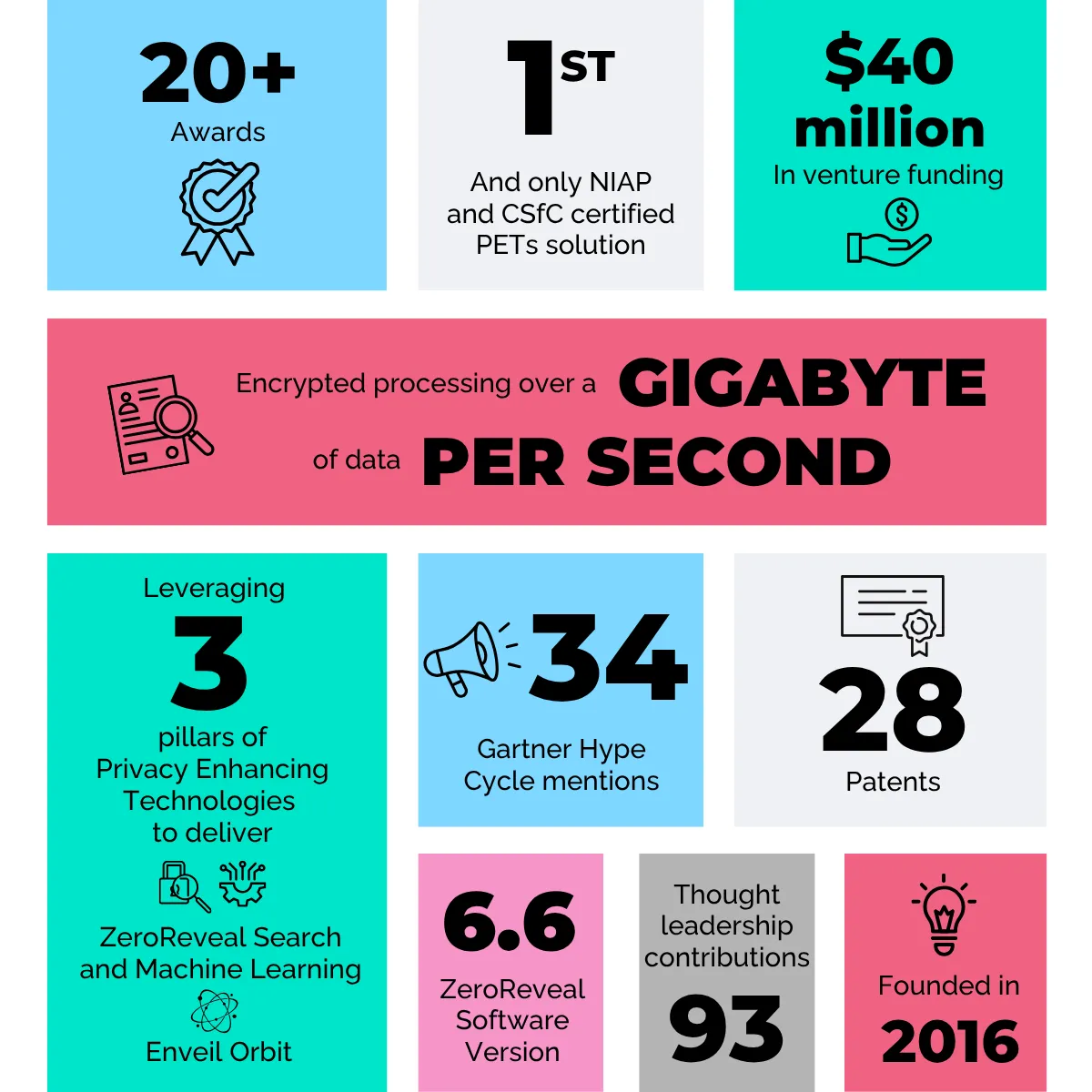
As a Privacy Enhancing Technology solution provider that has operated in the space for nearly a decade, we are uniquely positioned to provide insight from an innovator’s perspective. Founded in 2016 by U.S. Intelligence Community alumni, Enveil leverages the power of Privacy Enhancing Technologies (PETs) to protect the usage of data. Customers use our software to extract insights, cross-match, search, analyze, and utilize AI across boundaries and silos at scale without exposing their interests or compromising the security or ownership of the underlying data.
Committing to a Collaborative Solution
Modern fraud, including AML/CFT, is not confined to any single institution or sector, and industry stakeholders must collaborate widely and more effectively in order to prevent it. The core problem is well-recognized: bad actors operate across operating jurisdictions, financial services, telecommunications infrastructure, online platforms, and digital marketplaces simultaneously with ease – while those trying to combat the criminal activity do not. It is no surprise that an increasing number of event panels, roundtables, white papers, and strategy documents reach the same conclusion: data collaboration at scale is the key to effective AML/CFT programs.
We believe emphasizing the need for cross-silo data collaboration and investing in the advancement of innovative, privacy-enhancing capabilities as part of the efforts to modernize the Bank Secrecy Act (BSA) will benefit individuals, organizations, and society.
Identifying Data Sharing Barriers
Organizations must be able to collaborate and leverage third-party, open-source, commercially-available, and cross-silo data resources while protecting business objectives, complying with regulatory guidance, and respecting privacy boundaries. There are a number of barriers that currently limit cross-silo data and intelligence sharing:
A lack of clear incentives that address cost and regulatory risk: Organizations need regulatory clarity to justify the investment of resources in collaboration efforts and the innovative technologies that enable them.
Legal ambiguity: Stakeholders need legal clarity to help manage legal risk, especially in relation to the use of emerging technologies.
A better understanding of new technologies: Criminal actors and networks move fast to adapt to technological change, but organizations are often delayed in adopting new methods, particularly third-party solutions.
A fragmented data-sharing environment: There are wide differences between cross-sector approaches to data collaboration where a regulatory-guided approach could make participation easier and lower cost.
These are challenges that Privacy Enhancing Technologies (PETs) are uniquely positioned to address.
A Technology-Enabled Solution
At its core, PETs are a family of technologies that enable, enhance, and preserve the privacy of data throughout its lifecycle, playing an important role in enabling secure cross-boundary, cross-sector, and cross-jurisdictional collaboration. While many PETs have been the subject of research for more than five decades, technology breakthroughs have made them computationally practical at scale for a growing list of business and mission use cases. The PETs category is making its mark as a foundational technology of the digital transformation era for its unique ability to protect the usage of data at scale.
To highlight this value, here are four areas where Privacy Enhancing Technologies can enhance anti-money laundering and counter terrorism workflows:
PETs uniquely foster secure and private data usage and collaboration. The ability to overcome data silos and barriers to leverage data securely and privately changes the game. PETs allow banks and other stakeholders to securely utilize sensitive and regulated data across jurisdictions, organizational boundaries, and regulatory barriers without compromising data integrity, exposing sensitive assets, or increasing risk. This enables cross-silo collaboration that can reduce exploitable blind spots and create a harder operating environment for bad actors.
PETs are business and mission enabling. The amount of available data, the silos around that data, and the organizational need to extract value from many data sources will continue to grow in the years ahead. The need for secure data usage across these silos, uniquely made possible via PETs-powered capabilities, has never been greater.
Standardization and regulatory actions are catalysts to the adoption of PETs. PETs are ready and are being adopted today; there are solid examples of PETs being used at scale to solve business and mission challenges. While the capabilities PETs enable are transformational and thus organizations are moving forward with their use, wide-scale adoption would be accelerated if standardization bodies provided some broad implementation guidance. Further, if regulated organizations are incentivized by regulators to put PETs to use in operational settings, such as for financial crime detection and prevention, it will have a substantial impact on broader adoption.
PETs enable Secure AI. Organizations everywhere are looking for ways to implement AI without compromising security, and that is made possible through the use of PETs. PETs-powered capabilities provide an innovative path to extracting critical insights and driving collaboration while preserving Intellectual Property, data privacy requirements, and compliance standards. PETs contribute to the broader AI/ML landscape in two substantial ways: by protecting models during evaluation (also called inference) and training, allowing an organization’s focus to remain on the benefits of the results derived rather than the risks inherent in the ML model itself and its surrounding activity.
Further, the PETs category has seen a surge of interest driven by market factors such as consumer demand for privacy and a quick-moving, heterogeneous regulatory landscape. By keeping sensitive search terms, analytics, and machine learning models protected throughout the processing lifecycle, PETs allow users to securely derive insight from multiple decentralized data sources, even when using highly sensitive or regulated data.
Data-Driven Value, Powered By Privacy Enhancing Technologies
PETs enable secure analysis across decentralized datasets without aggregating or exposing the underlying sensitive data. By protecting data while it is being processed, PETs mitigate legitimate concerns around data privacy, confidentiality, regulatory scrutiny, and commercial sensitivity, allowing organizations to collaborate with confidence.
PETs have been widely recognized as a key enabler of data-driven collaboration, and are a prerequisite for building the kind of networked intelligence the AML/CFT ecosystem demands. Beyond contributing to the fight against criminal activity, cross-silo secure data collaboration can deliver significant operational value. If institutions securely collaborate at scale, they can reduce investigative inefficiencies, improve detection earlier in the fraud lifecycle, and streamline compliance and risk operations that today operate within a “single institution view”.
More effective collaboration has the potential to materially reduce the cost of operating fraud, risk, and compliance functions. It can also improve outcomes through enhanced understanding, and drive faster and better informed decisions.
Next Steps to Spur Action
To encourage technology-enabled collaborative efforts across industry stakeholders, FinCEN could provide greater direction on data and intelligence sharing as part of its modernization efforts, including:
Fund and facilitate operational pilots to broadly understand and evaluate the impact of new technologies such as PETs — efforts that should include a wide-range of public and private stakeholders — to produce a common understanding of how these technologies can advance AML/CFT workflows.
Encourage cross-bank, cross-jurisdiction, and cross-sector collaboration efforts that will help facilitate secure and efficient data usage across silos and boundaries.
Direct leaders from FinCEN and other Department of the Treasury entities, as appropriate, to create and manage a standardized lexicon for data and intelligence sharing.
In a threat landscape where illicit financial networks already operate as coordinated ecosystems, organizations must be empowered to collaboratively produce intelligence across networks in order to gain advantage. FinCEN’s modernization guidance should emphasize collaboration, made secure and private via the power of innovative technologies. It is time to create a foundation upon which stakeholders can build distributed intelligence networks that more effectively combat fraud and enhance the institutions fighting it.
Enveil is a pioneering Privacy Enhancing Technology company protecting Data in Use. Enveil’s business-enabling capabilities change the paradigm of how and where organizations can leverage data to unlock value. Defining the transformative category of Privacy Enhancing Technologies (PETs), Enveil’s award-winning ZeroReveal® and Enveil Orbit® solutions for secure data usage, collaboration, monetization, and Secure AI protect the content of the search, analytic, or model while it's being used or processed. Customers can extract insights, cross-match, search, analyze, and leverage AI across boundaries and silos at scale without exposing their interests and intent or compromising the security or ownership of the underlying data. A World Economic Forum Technology Pioneer and Gartner Cool Vendor, Enveil is deployed and operational today, revolutionizing data usage in the global marketplace.