In this article, Enveil CEO Ellison Anne Williams discusses the attributes that make Privacy Enhancing Technologies stand out as data collaboration enablers.
Excerpt:
Data quite literally powers the world. Businesses across verticals are constantly evaluating inputs, extracting insights, and looking for data-driven ways to optimize and expand. While organizations may have once been limited to assets collected and retained within their operations, valuable data can now come from anywhere. Business and IT leaders increasingly leverage data from commercial and other third-party data sources, including partner entities. We all want access to more data and the ability to utilize broader, more diverse datasets — especially for data-hungry functions such as AI/ML — that can provide both near- and long-term advantages. This is what makes the idea of leveraging data from a variety of entities so appealing.
Acknowledging the risks
But, no matter how much value a data-sharing agreement may provide, there are few circumstances where business leaders will capture that advantage by sacrificing ownership or control of their assets. Once data is shared, pooled, or changed hands, control is gone.
Even if a dataset seems innocuous today, it’s impossible to predict what the future holds and how technology developments might change your perspective of the data’s value.
Take, for example, the advances in AI/ML that have taken place in just the past 18 months, including the introduction of publicly available, widely recognisable tools that have certainly not seen a shortage of hype. Large Language Models (LLMs) are being trained over expansive data sources whose owners likely never envisioned they would be consumed in such a way. This brings to light a number of privacy, security and regulatory challenges that are extremely challenging to tackle.
Beyond the loss of control, organisations interested in data-driven collaboration also need to consider the impact on their risk profile.
A patchwork of regulatory policies aimed at protecting privacy blanket the globe, with more emerging every day. There is little consistency so just keeping up with the guidance and restrictions can be challenging for organisations operating in multiple jurisdictions.
In many regions, data owners could be liable for misuse of data shared which may hamper collaboration efforts before they even get off the ground. It’s hard to justify the possibility of legal exposure or reputational damage no matter what value the shared effort may deliver.
Turning to technology
So do these types of challenges kill the idea of data collaboration altogether? Thankfully the answer to that question is no. The desire (and necessity) to share and collectively utilize data is one of the reasons for the growth in awareness around Privacy Enhancing Technologies (PETs), a family of technologies that enhance, preserve, and enable the privacy and security of data throughout its lifecycle.
While there is an abundance of reports and case studies on the value of PETs from influential global entities, including regulatory and government bodies in the UK, US and Singapore, the impact of these technologies is most consequential for use cases where data needs to be both used and protected. This is what makes them uniquely suited to enable data collaboration efforts.
This category, which includes technology pillars such as homomorphic encryption, secure multiparty computation, and trusted execution environments, allows organizations to work together to leverage assets in a way that does not require the transfer of data ownership or risk violating legal barriers by exposing sensitive or regulated assets.
Collaboration without compromise
Here are three attributes that make PETs stand out as data collaboration enablers:
Decentralized data usage. One of the most powerful qualities of PETs is the ability to extract value from data where it is today. By eliminating the need to replicate or pool data, data owners can retain positive control of their assets. This limits or eliminates the risk of misuse and unintended exposure. In many circumstances, it also lowers the bar for partnerships and collaboration by retaining a trust boundary that can be defined and adjusted based on the shifting needs of the effort. For example, the data owner may want to restrict usage to a portion of the dataset, such as sharing high-level location data (country, province, state) but not exact addresses. Or they may want to shield information that may expose competitive advantage or IP. PETs give users this flexibility, enabling data value extraction while protecting the interests of both parties.
Data-centric protection. By protecting data while it’s being used or processed, PETs uniquely help ensure that sensitive data remains secure at all times. This supports a core concept of the Zero Trust movement in which organizations operate under the assumption that systems have been compromised. For data collaboration, the ability to focus protection efforts on the sensitive assets themselves is important because it allows data to be leveraged at a more granular level. For example, think about the ability to run an encrypted search over a partner’s dataset where the sensitive content of the search (PII, company-sensitive info, etc.) remains encrypted throughout the processing lifecycle, ensuring the interests and intent of the requesting party remain protected. This PETs-support, data-centric approach is more sustainable because it can be designed with flexibility and adaptability in mind.
No one size fits all. There are a number of technologies within the PETs category, including the three referenced earlier in this article. Each has its own attributes that can add value depending on use case requirements. In an emerging category like PETs, there is a tendency to pit these technologies against each other. The reality is that choosing the right ones depends on use case requirements, infrastructure, and the desired level and type of protection. PETs can, and often do, work together. For example, organisations can use secure multiparty computation and homomorphic encryption techniques in conjunction with a trusted execution environment. The end user’s ability to dictate needs such as security and performance will help determine which technology is best suited for a given scenario.
PETs offer the ability to privately and securely collaborate with data across multiple entities and data silos, offering businesses the value they need to advance their objectives without elevating risk. This expands not only what data sources can be leveraged but also enables businesses to think beyond traditional partnerships by working with organizations that may have once been considered too close for comfort from a competitive standpoint. By ensuring protection for the interests of both data owners and data consumers, this technology-enabled approach to collaboration can deliver business value in ways that were not previously possible.
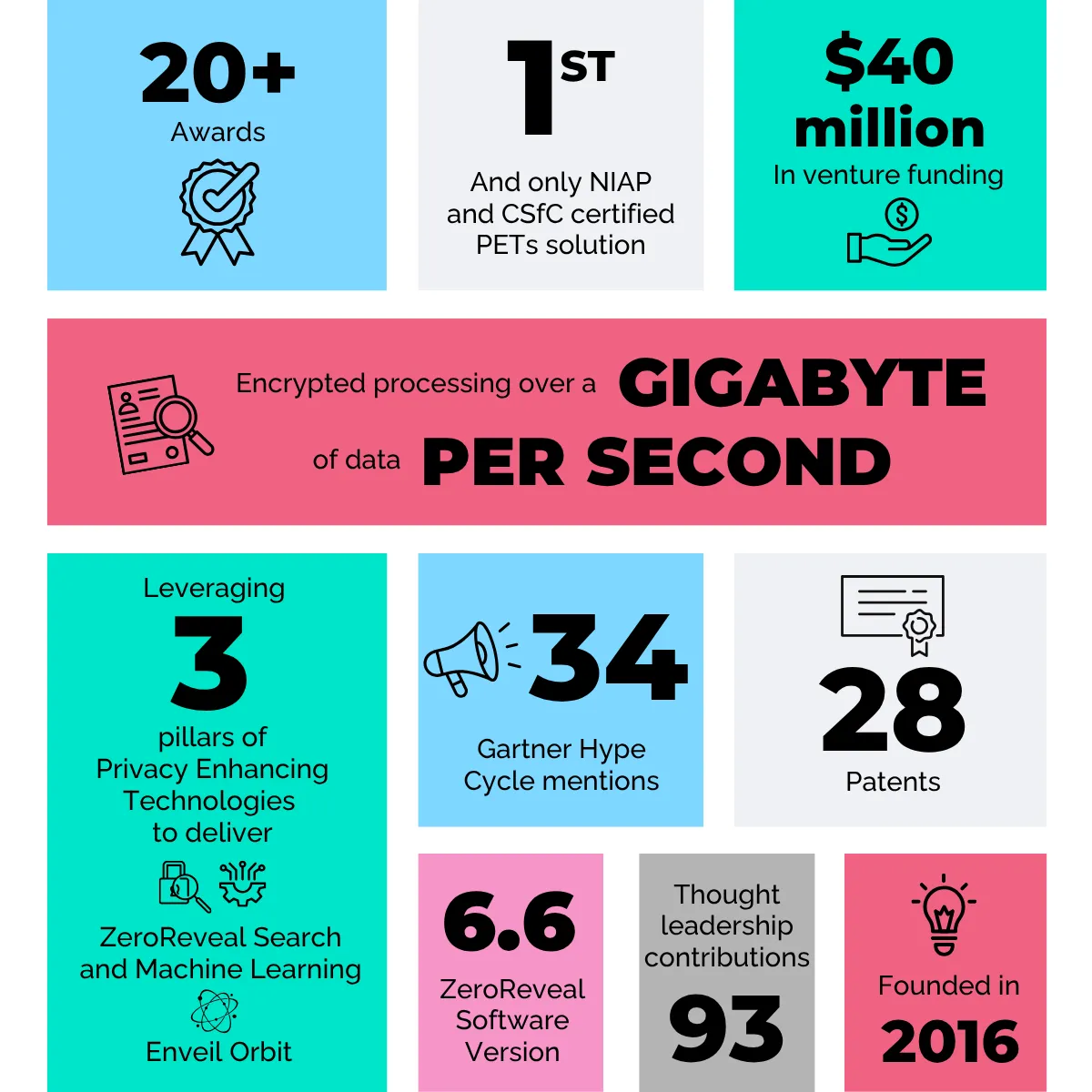
Enveil is a pioneering Privacy Enhancing Technology company protecting Data in Use. Enveil’s business-enabling capabilities change the paradigm of how and where organizations can leverage data to unlock value. Defining the transformative category of Privacy Enhancing Technologies (PETs), Enveil’s award-winning ZeroReveal® and Enveil Orbit® solutions for secure data usage, collaboration, monetization, and Secure AI protect the content of the search, analytic, or model while it's being used or processed. Customers can extract insights, cross-match, search, analyze, and leverage AI across boundaries and silos at scale without exposing their interests and intent or compromising the security or ownership of the underlying data. A World Economic Forum Technology Pioneer and Gartner Cool Vendor, Enveil is deployed and operational today, revolutionizing data usage in the global marketplace.